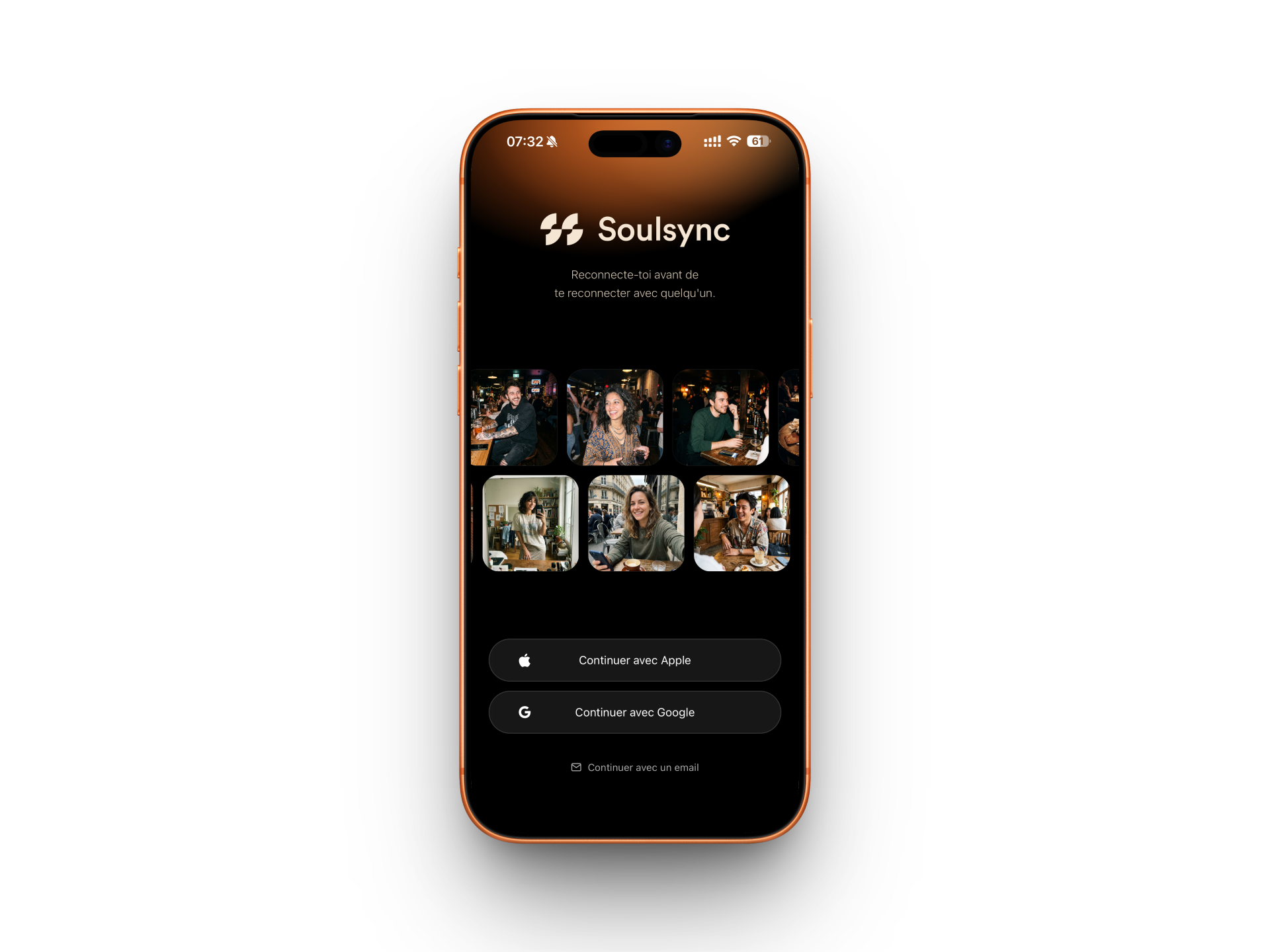


The app
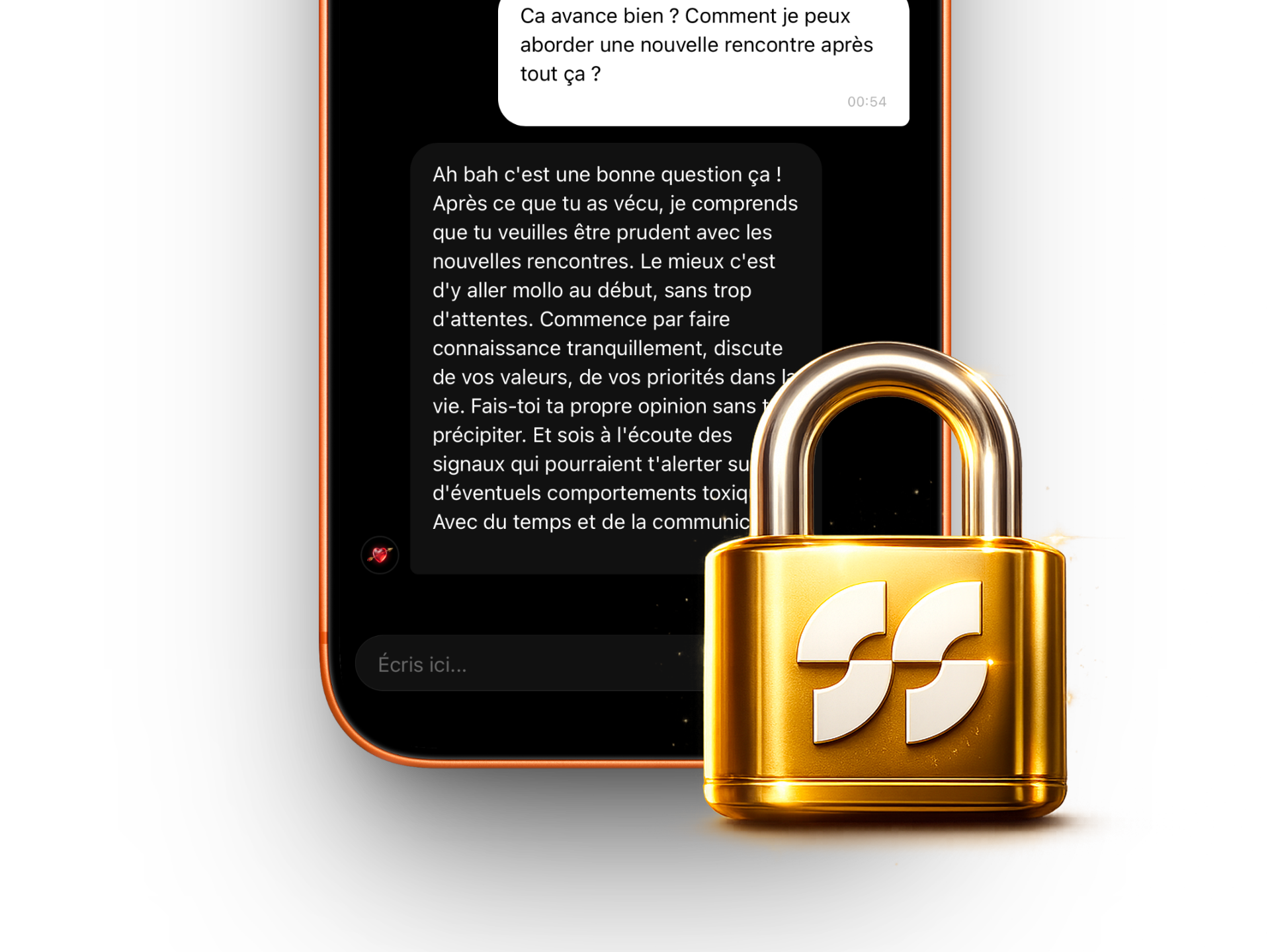
Cupidon
The matchmaker, not the algorithm.
The journey
Eleven steps before the first date.
My Garden
Understand yourself, before you meet someone.
The Soulsync universe
Soulsync Library
Books, podcasts and videos on love, attachment and the self.
Soulsync Lab
Eighty years of research on connection, read for you.
Soulsync Safety
Your data protected, and harm-free encounters. European hosting, zero resale, caring moderation.
Research unit
Soulsync Lab
The science behind every decision.
We didn't invent slowness. We read what eighty years of research say about meeting someone, and we built from there.
What we think we know
Six sayings about love.
What research actually says.
Dating is a subject everyone has an opinion on. For each received idea, here is the study, the researcher, and the published result.
01 / 06
Popular belief
« Opposites attract. »
02 / 06
Popular belief
« When you know, you know. »
03 / 06
Popular belief
« There's only one soulmate. »
04 / 06
Popular belief
« True love takes no effort. »
05 / 06
Popular belief
« The more choice, the better you find. »
06 / 06
Popular belief
« You recognize love at first sight. »
What follows
Six product decisions, six research findings.
Every choice Soulsync makes rests on published, peer-reviewed work. Here's how.
« Romantic love is not an emotion. It's a motivation system, a brain state oriented toward choosing a partner. »
Six decisions, six foundations
Compatibility can't be predicted. It's lived.
The largest scientific review on the subject concludes that algorithms based on similarity or complementarity have almost no predictive value. What predicts the quality of a couple is the way two people interact, not a score calculated before they ever speak.
Finkel, Eastwick, Karney, Reis & Sprecher (2012), Psychological Science in the Public Interest.
→ Soulsync doesn't sell a magic algorithm, but an eleven-step journey that generates real interaction.
Too much choice makes us unable to choose.
Beyond a handful of options, satisfaction and engagement collapse. In online dating, an abundance of profiles degrades the quality of decisions and increases regret over the choice made.
Iyengar & Lepper (2000), JPSP; D'Angelo & Toma (2017), Media Psychology.
→ Connexion Day shows you four profiles a day. Not four hundred.
We love what resembles us, on the essentials.
Eighty years of work converge: similarity, especially of values, predicts attraction and satisfaction. The famous "complementary needs theory" has never been solidly confirmed. The complementarity that lasts isn't of character, it's of life trajectories.
Byrne (1971); Winch (1958), refuted; Montoya, Horton & Kirchner (2008), JSPR.
→ Soulsync matches you on your deep values, then lets you discover how you complement each other.
Loving, as an adult, is replaying an attachment story.
The way we bond as adults extends our early attachment patterns. Understanding your own style, secure, anxious, avoidant, changes how you enter a relationship, and what you seek in it.
Bowlby (1969); Ainsworth et al. (1978); Hazan & Shaver (1987), JPSP.
→ Sign-up begins with your emotional state and relational pattern, not your height or your job.
Intimacy is built through gradual disclosure.
A famous experimental procedure showed that strangers could develop lasting closeness by revealing themselves progressively, in steps of increasingly personal questions. Intimacy comes from reciprocity, not performance.
Aron, Melinat, Aron, Vallone & Bator (1997), PSPB; Reis & Shaver (1988).
→ It's the architecture of the eleven steps: the same question, the values game, the pact. A disclosure between two, step by step.
The voice reveals what text conceals.
With identical content, an answer heard, not read, makes the other person seem more thoughtful, more human, more worthy of consideration. The voice carries a presence that writing erases.
Schroeder, Kardas & Epley (2017), Psychological Science.
→ The eighth step of the journey is a voice question. The voice changes everything.
Our scientific honesty
What science forbids us to promise.
The research is clear: no algorithm, to this day, can predict who will make whom happy. So we will never tell you that we've "found the person of your life" before you've met them. That would be scientifically false.
What we do know how to do is create the conditions research associates with lasting connections: less choice, more attention; gradual disclosure; voice before face; time before the first drink.
The rest is yours.
Bibliography
Published, peer-reviewed work, cited in APA format. Each is available in a university library or via its DOI identifier.
- 01
Ainsworth, M. D. S., Blehar, M. C., Waters, E., & Wall, S. (1978). Patterns of Attachment: A Psychological Study of the Strange Situation. Lawrence Erlbaum Associates.
- 02
Aron, A., Melinat, E., Aron, E. N., Vallone, R. D., & Bator, R. J. (1997). The experimental generation of interpersonal closeness: A procedure and some preliminary findings. Personality and Social Psychology Bulletin, 23(4), 363–377.
- 03
Bowlby, J. (1969). Attachment and Loss, Vol. 1 : Attachment. Basic Books.
- 04
Byrne, D. (1971). The Attraction Paradigm. Academic Press.
- 05
D'Angelo, J. D., & Toma, C. L. (2017). There are plenty of fish in the sea: The effects of choice overload and reversibility on online daters' satisfaction with selected partners. Media Psychology, 20(1), 1–27.
- 06
Finkel, E. J., Eastwick, P. W., Karney, B. R., Reis, H. T., & Sprecher, S. (2012). Online dating: A critical analysis from the perspective of psychological science. Psychological Science in the Public Interest, 13(1), 3–66.
- 07
Fisher, H. E., Aron, A., & Brown, L. L. (2005). Romantic love: An fMRI study of a neural mechanism for mate choice. The Journal of Comparative Neurology, 493(1), 58–62.
- 08
Gottman, J. M., & Levenson, R. W. (2000). The timing of divorce: Predicting when a couple will divorce over a 14-year period. Journal of Marriage and Family, 62(3), 737–745.
- 09
Hazan, C., & Shaver, P. (1987). Romantic love conceptualized as an attachment process. Journal of Personality and Social Psychology, 52(3), 511–524.
- 10
Illouz, E. (2012). Why Love Hurts: A Sociological Explanation. Polity Press.
- 11
Iyengar, S. S., & Lepper, M. R. (2000). When choice is demotivating: Can one desire too much of a good thing?. Journal of Personality and Social Psychology, 79(6), 995–1006.
- 12
Montoya, R. M., Horton, R. S., & Kirchner, J. (2008). Is actual similarity necessary for attraction? A meta-analysis of actual and perceived similarity. Journal of Social and Personal Relationships, 25(6), 889–922.
- 13
Reis, H. T., & Shaver, P. (1988). Intimacy as an interpersonal process. In S. Duck (Ed.), Handbook of Personal Relationships (pp. 367–389). Wiley.
- 14
Rosenfeld, M. J., Thomas, R. J., & Hausen, S. (2019). Disintermediating your friends: How online dating in the United States displaces other ways of meeting. PNAS, 116(36), 17753–17758.
- 15
Schroeder, J., Kardas, M., & Epley, N. (2017). The humanizing voice: Speech reveals, and text conceals, a more thoughtful mind in the midst of disagreement. Psychological Science, 28(12), 1745–1762.
- 16
Winch, R. F. (1958). Mate Selection: A Study of Complementary Needs. Harper & Brothers.
- 17
Zajonc, R. B. (1968). Attitudinal effects of mere exposure. Journal of Personality and Social Psychology, 9(2, Pt. 2), 1–27.
« Reading the research means refusing to treat people as data. »
Are you a researcher?
Sociology, attachment psychology, anthropology of love. If your work intersects with ours, write to us. Soulsync Labs opens its scientific committee in early 2027.
Write to LabsComing soon on iPhone and Android
The app you delete together.
Four people chosen for you each day. Time to truly meet. Download Soulsync, let Cupidon do the rest.